
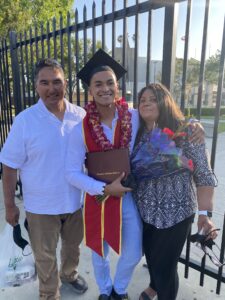
Please join us in welcoming CIRI Descendant John Adam Sallee IV (Iñupiaq) to the CIRI team! John came on as manager of CIRI Shareholder and Descendant communications in October. In this new role, he will develop content and strategies that inform, engage, and inspire Shareholders and Descendants. John is a former CIRI intern, having spent the summer of 2016 in the Corporate Affairs department.
Rooted in tradition yet focused on the future, John is charting a meaningful path that blends cultural pride with professional purpose. The Raven’s Circle sat down with him to discuss connection, resilience and belonging, and how to honor one’s own heritage in a rapidly changing world.
What has been your CIRI journey specifically, and your journey as an Alaska Native person more generally?
I am half Iñupiaq, with family roots in Nome, Alaska. My dad, John Adam Sallee III, is an original CIRI enrollee. My Alaska Native name is Little Rock, which was given to me by my grandmother, Mary A. Sallee.
My introduction to CIRI began with the summer internship program in 2016, and I was recently hired as the manager of Shareholder and Descendant communications.
I started the CIRI summer internship just as I was turning 21. When the opportunity arose, I thought, why not? What do I have to lose? And I absolutely fell in love—not only with CIRI as a company, but the experiences I had as an intern set me up for wanting to pursue a career in storytelling and communications.
The internship program was the three best months, professionally and educationally, I have ever had. I always knew I would come back (to CIRI) in some way, shape or form—I just didn’t know when. It was a matter of waiting for the right opportunity.
Where did you grow up? Were you raised with a strong sense of Alaska Native identity?
I lived in Eagle River (a community between Anchorage and Wasilla) during elementary school, then came to Anchorage for middle and high school. My father is full-blooded Iñupiaq, while my mother is Mexican. I was always seeking that balance of, where do I fit in this picture?
My dad really did have such a positive influence over my identity as an Alaska Native person, particularly when it came to subsistence activities. I’m so glad he encouraged me to do those activities, because now I have such an appreciation for them—what they mean and how they’re passed down from generation to generation.
Growing up in Eagle River, the culture around being Native was to feel ashamed. I would hear people around me saying, “Don’t tell anyone you’re Native, they won’t like you.” There were very few other Native kids, so I did feel alone in that regard.
Attending middle and high school in Anchorage opened up so many avenues of Alaska Native culture for me, not only educationally, but in forming relationships with other Native and multi-ethnic people.
I graduated from Bartlett High School in 2013 and started at the University of Alaska Anchorage (UAA) that fall, pursuing a bachelor’s degree in journalism and public communications.
What put you on the path of wanting to work in Native media and communications?
My first internship ever, even before the one I had with CIRI, was with KNBA 90.3 FM/Koahnic Broadcast Corporation. It was my first experience not only working in communications but working in Native media. I knew I wanted that to be my career path.
In 2016, I interned in CIRI’s Corporate Affairs department. The best part of my CIRI internship was working with Jason Moore. [Editor’s note: Jason Moore served as senior director, CIRI Corporate Affairs, from 2013 until his passing in 2018.] He was just such a guiding force when it came to media and communications. His best advice for me was to keep traveling and to just have fun, which translated to so many of the projects we did during that time. My fellow interns were awesome; I’m still in touch with some of them today.
I’m the youngest of four siblings. My older sister, Alexis, is a filmmaker and radio producer, and she’s been a life-long role model for me. As a communicator, you want to approach stories with care and respect. But we want to have fun with our media, especially as Native people, because humor is one of our traditional values.
After graduating from UAA in 2018, I knew I wanted to leave the state. I had lived in Alaska all my life, and I wanted to see and experience another part of the country. As soon as I walked onto the campus of the University of Southern California (USC), I knew it was where I was meant to be. During my college tour I was able to meet some of the professors specifically within the public relations (PR) department, and they encouraged me to apply. I wrote about my experiences in Alaska for my application essay, and I ended up being accepted to the USC Annenberg School for Communication and Journalism.
I was discouraged from applying (to USC) by those I knew—“Oh, it’s a bunch of rich kids, it’s so expensive.” But I went with the beat of my own drum; I knew I could get in. It was just a matter of believing in myself.
What was your time at USC like?
I ended up pursuing a master’s degree in PR and advertising. For one of the assignments for an improvisational leadership class, we were required to record a two-minute video. It was a class with 15 other students. A lot of them just talked at the camera, but I recreated the intro scene from the movie “Ferris Bueller’s Day Off” with a personalized script based on my Alaska Native and Hispanic heritage. I will say, out of any assignment I’ve ever had, it was the most effective in letting people know who I am and what I stand for.
I was able to land a paid internship each semester, and I made a point of doing different categories of PR—entertainment, beauty, lifestyle—so I could get a taste of what was out there and where I best fit in.
Career-wise, what did you do post-graduation?
After graduating from USC, I began my career in communications and brand strategy, working with global and national organizations across technology, travel and media. I supported major clients like Amazon Customer Innovation, Amazon Prime, Bose and LG at Hill + Knowlton, and led earned-media efforts for the Expedia Group brands. The work I was doing was great, but I really wanted a job that aligned with my values of celebrating culture and uplifting community.
My grandmother’s health began declining, and I knew I needed to come home. In fall of 2024, I moved back to Anchorage and started working in brand storytelling and partnerships with Koahnic Broadcast Corporation. When the Shareholder and Descendant communications position with CIRI came online, I knew I had to apply.
What do you hope to accomplish in your new role at CIRI?
I’m elated to be back at CIRI because the organization and the people have always felt like home. CIRI has such a powerful story rooted in culture, land and people, which I’m proud to carry forward. In my new position, I am excited to help build stronger ties between our Shareholders and Descendants, elevate our voices, and keep sharing our stories in a way that respects our identity and origins.
What would be your advice to young Alaska Native people who want to strengthen ties with culture?
To young Alaska Native people, I would say to get out of your comfort zone. It will feel at times uneasy, like interacting with executives or just meeting people you’ve never met or had a conversation with. But we have a lot more in common than we think.
For example, I received a fellowship to attend the 2025 Arctic Encounter Summit, which explores critical issues such as climate resilience, economic innovation, and energy and resources. The prime minister of Denmark was there, and she was talking about fireweed. The Danish people use fireweed in a completely different way than Alaska Native people. That connection made me realize that we are more connected than we often believe. Ultimately, we are all just trying to live, work, survive and thrive on this planet.