
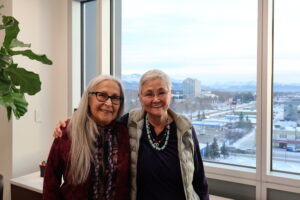
Recently, after an Elder storytelling event that was part of CIRI’s Next Gen Day (Jan. 19), the Raven’s Circle had the opportunity to sit down with two Alaska Native Elders who were in the building to share stories and lessons with the young participants.
CIRI Shareholders Ella Anagick (Iñupiaq) and Mary Walker (Koyukon Athabascan/Iñupiaq) grew up in rural villages in large families grounded in a subsistence lifestyle, and each went on to pursue higher education and raise families of their own. In the conversation that follows, they reflect on the experiences that shaped them, the lessons they’re proud to pass on and the resilience that carries them forward.
What is your family heritage, where did you grow up and what is your connection to CIRI?
Mary: On my father’s side, I’m Koyukon Athabascan and some Tlingit; my mother’s side is Iñupiaq. I inherited CIRI shares from my cousins. I’m an original enrollee of Doyon, Limited and an enrolled member of the Holy Cross Tribe. I was born in Holy Cross and grew up about a mile away from the village; my grandfather had a homestead there.
Ella: I’m Iñupiaq; my dad was Mahlemut and my mother was Kaweramute. I’m an original enrollee of Bering Straits Native Corporation and an enrolled member of the Native Village of Unalakleet. I was gifted CIRI shares by my sister, original enrollee Dorothy Anagick. I grew up in Unalakleet.
What are some memories you have from your childhood?
Mary: I have lots of memories. One that stands out is, my dad worked as a captain for Yutana Barge Lines. He got an old military Jeep. We had to go to church, and he took us down on the slough. It was snowing. I remember driving home feeling so safe and seeing all that snow coming down. It was dream-like. You knew you would make it home safely because Dad was in charge.
Ella: It was a hard life; it was a subsistence lifestyle. I was the fourth of nine kids. In the summer, we would spend hours either working in my mother’s garden or out picking berries. There was an Air Force base there; this was during the Cold War. Every time there was a flood, they had the big blue trucks and they would come in and evacuate the village.
Growing up, what was your education like?
Mary: I went to kindergarten, and their way of controlling children was to whack their hands with a ruler. My mom took me out (of school) and she taught me first grade at home. After that, it was the Catholic nuns and priests and lay volunteers and brothers and whoever they threw into the classroom. None of them certified, until about the eighth grade.
Ella: I went to school in Unalakleet, but I did end up going to Mt. Edgecumbe (in Sitka, Alaska) my junior year, and I was selected to attend the Upward Bound program in Fairbanks during the summers. At one point, they were going to have six kids from the Upward Bound program go to Hawaii, and then the next year, six kids from Hawaii would reciprocate. I was one of the six selected to fly to Honolulu; I ended up staying with a Japanese family. I love sushi to this day.
Mary: When it was time for high school, I was sent to Chemawa in Oregon for a year. I was the youngest of six, and our whole family was split up for school. When they tried to send me to New Hampshire, I told my sister, “I’m not getting on the plane.” She didn’t want to go back to Oklahoma, so she hid with me. They didn’t pick us up because we were hiding in the woods in the fall time in our village. After that, the BIA told my parents we’d attend school in Anchorage, where we were placed in a boarding home.
My sister soon went back home, and I struggled, too, until my counselor suggested a foreign studies trip. I finally agreed, and with about 100 Alaska students under the BIA, I traveled to Spain, Denmark and Portugal. When we returned, we were given the choice to finish high school or attend Alaska Methodist University (now Alaska Pacific University), since the college had helped chaperone the trip. I chose the university, because most of us were already taking college classes at 16 or 17.
What about your educational journey post-high school?
Mary: I took classes at Anchorage Community College and UAA (University of Alaska Anchorage), and that’s where I got my undergraduate degree. I majored in English, minored in psychology and received a teaching certificate in elementary education. That’s how I became a teacher.
Ella: I knew I didn’t want to attend college in Alaska; I thought there’d be too much prejudice (against Native people). I asked a physics classmate, “What are the best schools on the West Coast?” She said that Stanford was one of them.
I majored in mathematics at Stanford and thought I was going to teach, but I remember as a child, my great-grandmother Miowak—she was a very spiritual, strong Christian woman—came to our house and said, “There will be two lawyers who will come out of this house.” We didn’t even know what a lawyer was, for goodness’ sake; we were totally isolated.
I ended up going to law school at Penn State in Carlisle, Pennsylvania, which was good preparation for (practicing law in) Alaska because of the federal Indian boarding school that was there. [Note: Between 1880 and 1910, nearly 200 Native American children died while in the government’s care at the Carlisle Indian Industrial School and were buried on its grounds. The school, guided by the motto “kill the Indian, save the man,” attempted to forcibly assimilate more than 7,800 children from over 140 Tribal nations through a combination of Western education and hard labor.]
You both pursued higher education and professional careers at a time when opportunities for Native women were far more limited. What motivated you as you began your professional journey, and how did you decide on the path that followed?
Mary: I was going to teach in Anchorage, but I did my student teaching in Holy Cross. I worked there for 20 years, and I also worked in Chevak and for the Fairbanks school district. I also worked here (in Anchorage) through Cook Inlet Tribal Council.
I also taught in Anvik, which is only about 35 miles up the river from Holy Cross. Having a classroom with your own relatives in there is kind of tough, but I treated them all the same; they were all precious little things. My favorite was grades four through six, but I taught them all.
Ella: I had my oldest daughter, Christina, as a single mother, and that was an impetus for me to pass the bar (exam). I’ve done corporate law, personal injury, criminal defense, felony misdemeanor, federal Indian law, probate… There aren’t too many Native lawyers in Alaska.
In the law, you deal with some of the hardest things, but I’ve always had a deep faith in Christ. I remember when I first started, going in and doing these trials, I was terrified. And then God would show me, through my thoughts, “I will go before you; I’m with you. I will never leave you or forsake you. Do not bear, do not be discouraged.” And I would take that and go in.
How did you approach raising your families while pursuing your careers, and what stands out to you from those years?
Mary: I have a son. He grew up in the village until he was in high school, when he chose to go to Galena to the GILA (Galena Interior Learning Academy). He grew up with the foods that were provided by our family— moose, fish, spruce hens, willow grouse.
I was lucky, because I had my parents to help out. My mom babysat my son as I started (teaching) at the school. My dad got a used vehicle, and I would drive it to work, from Ghost Creek to Holy Cross. Later, I got one of the houses in the village so I could be closer to work. When I moved, my mom moved right in with me.
Ella: I have three daughters. My daughter Christina is a neurologist at the Alaska Native Medical Center; Holly teaches Indigenous history at the University of New Mexico and wrote a book. Jennine is part of the Yah Executive program here at CIRI.
My own daughters grew up in Anchorage. I didn’t really pass on much in the way of subsistence, but they would go back to Unalakleet. I spent a lot of time working and trying to raise them. I took them to the Alaska Native Heritage Center, and I introduced them to our Native foods—berries, moose, caribou, salmon.
When you think about your life’s journey, what do you most hope to pass on to future generations?
Mary: Listen carefully to your Elders, because they have stories to be told, and there are lessons to be learned. Don’t just watch; listen. I think a lot of people don’t realize their worth until someone takes them by the hand and makes them feel good about themselves. Everybody needs to feel valued, because there’s good in everyone.
Ella: It’s been quite a journey; it’s like I’ve lived several lifetimes. But being around kids has kept me from being, I think, very hard and cynical. Our younger people that are coming into the world need to have role models to aspire to: “She can do it, so I can do it too,” you know?